
News & Updates
Check out the latest from Sudan and our movement
Thousands murdered as El Fasher falls to Rapid Support Forces
A fast-paced genocide is unfolding in the city, and it’s estimated over 3,000 Sudanese have already been killed. The actual death toll is likely far higher.
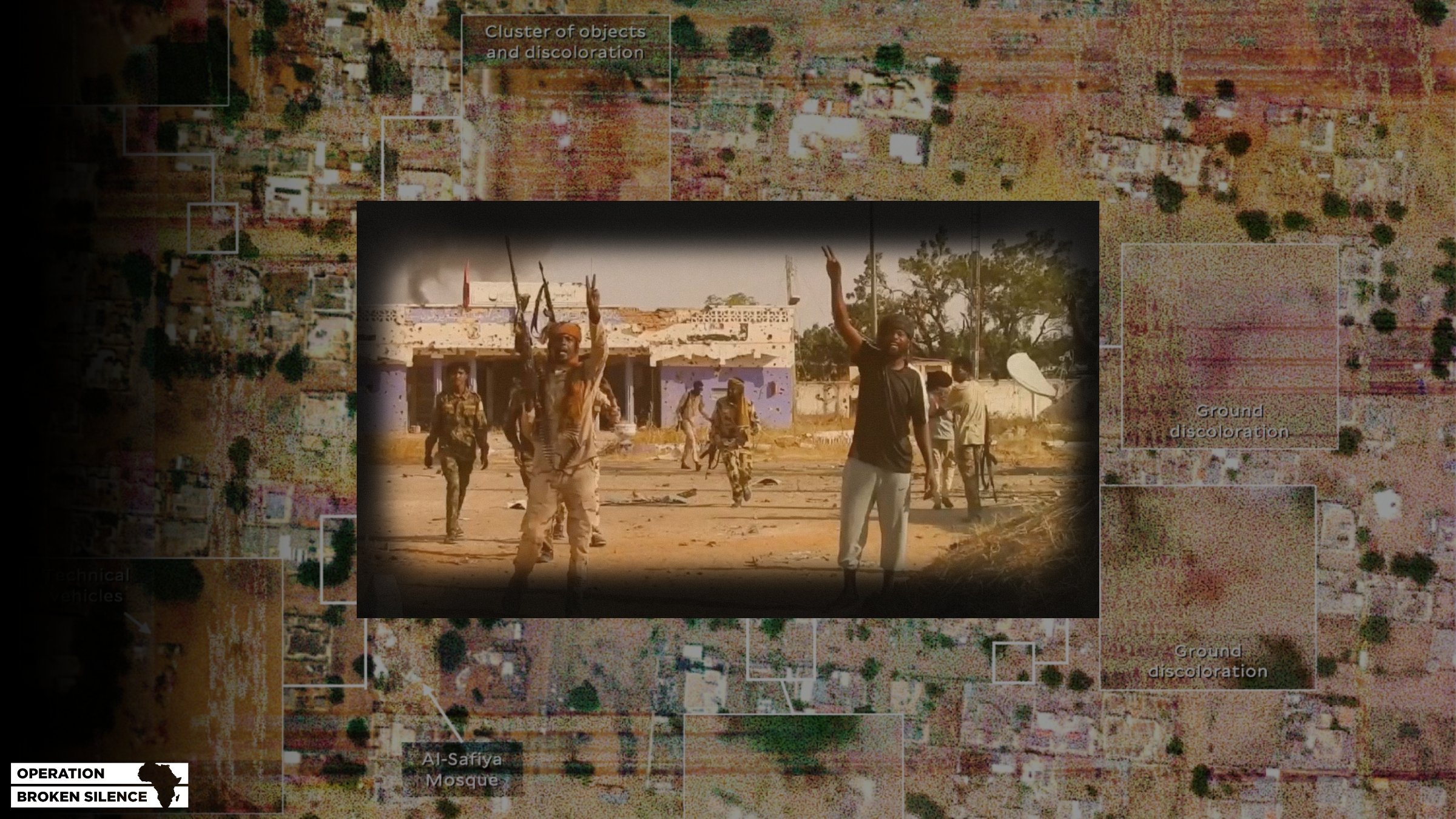
Background Image: Satellite imagery of El Fasher from Yale HRL. Foreground Image: RSF fighters in captured army base from social media.
A fast-paced genocide is unfolding in the city of El Fasher, Sudan. It’s estimated over 3,000 Sudanese have already been killed. The actual death toll is likely far higher.
•••••
The besieged capital of North Darfur and last army stronghold in western Sudan fell to the Rapid Support Forces (RSF) on October 26 and 27. The paramilitaries are now on a killing spree in the city, and the massacre is being committed at such breakneck speed that bodies and bloodstained soil can be seen by satellites.

Map: Location of El Fasher. (Operation Broken Silence)
El Fasher was surrounded by the RSF for nearly two years and under violent siege for most of that time. According to the United Nations, over one million people —almost certainly an undercount— have fled the Greater El Fasher area since the start of the war. It’s estimated 260,000 civilians, half of them children, remain trapped in the city today without aid.
Famine has been rampant in El Fasher for months, with many resorting to eating animal fodder to try to survive. Nearby displacement camps such as Zamzam and Abu Shouk were largely destroyed by extreme shelling and RSF looting throughout this year.
The army’s 6th Infantry Division, the Joint Forces —comprised of surviving Darfuri rebels from the 2000s genocide— and local militias had been defending El Fasher, supplied via infrequent airdrops by army cargo planes. After months of attritional attacks by the RSF and with dwindling ammunition, some of the army garrison and local officials managed to escape in a handful of armed convoys during the RSF takeover. Early reports suggest defending fighters who were left behind are being hunted down and executed by the RSF.
As we have noted for months in our own coverage, Sudanese in El Fasher were always going to be on borrowed time without a major and sustained outside intervention by either the army or international community. That intervention never came, deepening fears that when the RSF did capture the city, the genocidal paramilitary force would engage in a localized massacre on a scale unprecedented in our time.
The massacres are now underway
The RSF launched their final offensive on El Fasher roughly a week ago, breaching multiple defensive lines and invading neighborhoods from the north, east, and south. At some point over the weekend they seized control of the 6th Infantry Division’s headquarters —where some the heaviest armed resistance had been— forcing army troops and their allies to fall back into the city’s western neighborhoods.
Videos quickly emerged on social media showing RSF fighters inside army HQ and elsewhere in El Fasher. Virtually all communications networks in the city have since gone dark, and getting information out is now incredibly difficult. The army confirmed on Monday that its surviving forces have withdrawn from the city entirely.
What information that is available comes in the form of stories told by fleeing refugees, satellite imagery, and videos posted online by RSF perpetrators. Every indicator points to a massacre in progress, with the Joint Forces saying as early as Tuesday that the RSF had already executed more than 2,000 unarmed civilians. Sudan’s warring factions often inflate battlefield and civilian casualty numbers to try to boost their own standing, but this time it is likely an undercount, especially considering the speed at which the massacres are unfolding across the city.
Yale University’s Humanitarian Research Lab (HRL) has been tracking the situation in El Fasher using satellite imagery and open-source data for months. In an interview given Tuesday, Director Nathaniel Raymond said HRL has evidence consistent with mass killings:
“We are only at the beginning of a wave of violence,” he said. “I have never seen a level of violence against an area like we are seeing now. This is only comparable with a Rwandan style killing in the first 24 hours.”
Some of that evidence can be seen in two new reports issued by HRL, on October 27 and October 28, respectively. Multiple satellite images show “dark colored objects consistent with the size of human bodies” with “reddish ground discoloration” underneath in areas where the RSF is running house-to-house clearance operations. Translation: these are massacre sites with clusters of bodies and bloodstained soil.

Image by Yale HRL
In a press release on October 28, Yale HRL adds:
The Yale School of Public Health’s Humanitarian Research Lab (HRL) corroborates evidence of continuing mass killing in the past 48 hours since RSF took control of El-Fasher. These mass killing events include corroboration of alleged executions around Saudi Hospital and a previously unreported potential mass killing at an RSF detention site at the former Children’s Hospital in eastern El-Fasher. Yale HRL concludes that systematic killing in the vicinity of the earthen wall, hereafter berm, outside the city is continuing.
Mass Killing at Former Children’s Hospital, El-Fasher North Darfur (13.6217898, 25.3826549)
Apparent Mass Killing at Saudi Hospital (13.629694679116708, 25.329653418909288)
Systematic Mass Killings of People along the Berm
Red Crescent Society of Sudan (RCS) Office, El-Fasher (13.629489605115484, 25.356066434927207)
Survivor testimony has corroborated the nature of these killings:
A nurse working at El Fasher South hospital told The Guardian “They killed six wounded soldiers and civilians in their beds – some of them women. I don’t know what happened to my other patients. I had to run when they (RSF) stormed the hospital.”
The World Health Organization says that on October 28, six health workers, four doctors, a nurse and a pharmacist were abducted and that the RSF shot and killed over 460 patients and their companions in the hospital.
Meanwhile, the Associated Press is reporting that RSF fighters are going “from house to house, beating and shooting people, including women and children…Many died of gunshot wounds in the streets, some while trying to flee to safety, witnesses said.”
Over 26,000 individuals fled El Fasher on foot between October 26-29. Many headed toward Tawila roughly 34 miles west of El Fasher. That town and surrounding areas are under the control of an independent Sudan Liberation Army (SLA) faction, a surviving rebel group from a previous war. Tawila is now the last true safe haven in all of western Sudan and is already sheltering 650,000+ displaced people. Many new arrivals from El Fasher are showing up hungry and dehydrated, some wounded, and all with stories of losing loved ones.
A brief history of how we got here
Sudan is home to the world largest humanitarian emergency and one of the worst armed conflicts in modern history. Fighting between the army and RSF has left Khartoum in ruins. In the oppressed western Darfur region, entire communities are being annihilated by the RSF. Villages are burning and families are fleeing with nothing but the clothes on their backs. Hardly any of this ever makes international news, which goes to show just how horrifying this massacre is, that it’s finally breaking into news cycles.

Sudan Crisis Guide
Trying to make sense of the war in Sudan? We’ll get you up to speed in a few minutes.
Darfur is not only home to historically-persecuted African tribes, but also their main oppressor: the Rapid Support Forces. The RSF was born from the Arab militias that spearheaded the 2000s Darfur genocide. Those militias were known as janjaweed, a term loosely understood as devils on horseback. With arms provided by the Khartoum regime, the janjaweed massacred ethnically African villages and destroyed clean water wells, orchards and farms, and markets.
In 2013, the regime consolidated the janjaweed into the Rapid Support Forces and outfitted them with machine gun-mounted trucks, artillery and rockets, and anti-aircraft guns. The RSF quickly spread into other parts of Sudan and expanded into mercenary recruitment in Chad, Central African Republic, and even as far away as Mali.
The army teamed up with the RSF in October 2021, overthrowing a transitional government that was steering Sudan toward a democratic future. The RSF’s participation in the coup showed the paramilitary force’s power rivaled the army. Both sides expected to be the top player in a new regime. Predictably, in April 2023, the army and RSF went to war with each other in Khartoum. Hundreds of miles away in Darfur, communities braced for an inevitable return to mass killing.
Within days the RSF launched a long-planned assault on Darfur’s African tribes, most notably the Masalit in West Darfur, where an estimated 15,000 people were exterminated in the state capital alone. The situation spiraled further in October 2023, when the RSF launched a lightening offensive across Darfur that saw state capitals and towns fall. El Fasher was spared due to a fragile ceasefire brokered by local leaders. Many people unable to escape Darfur fled into the city, one of the last safe havens in all of western Sudan.
The El Fasher ceasefire fully collapsed in April 2024, when the RSF cut off the last road into the area, trapping a then-estimated two million Sudanese with dwindling food, water, and health services. The situation has worsened ever since, with the army and its allies barely able to fight off constant onslaughts by the RSF. While there have been moments when people have been able to escape El Fasher and the surrounding displacement camps en masse, many have been robbed, beaten, raped, and even killed by the RSF as they fled.
The big picture
At the time of this posting the RSF massacre is ongoing. The Sudan Doctors Network described the situation on Wednesday as “a true genocide…The massacres the world is witnessing today are an extension of what occurred in El Fasher more than a year and a half ago, when over 14,000 civilians were killed through bombing, starvation, and extrajudicial executions.”
The fall of El Fasher will loom large over all of Sudan in the coming months, if not years. The RSF now control all five state capitals in western Sudan and most of Darfur’s rural areas. RSF commanders deployed significant man/firepower to capturing and massacring El Fasher, and they paid a heavy price themselves for its capture. Several RSF leaders and countless fighters were killed by the city’s now-routed defenders.
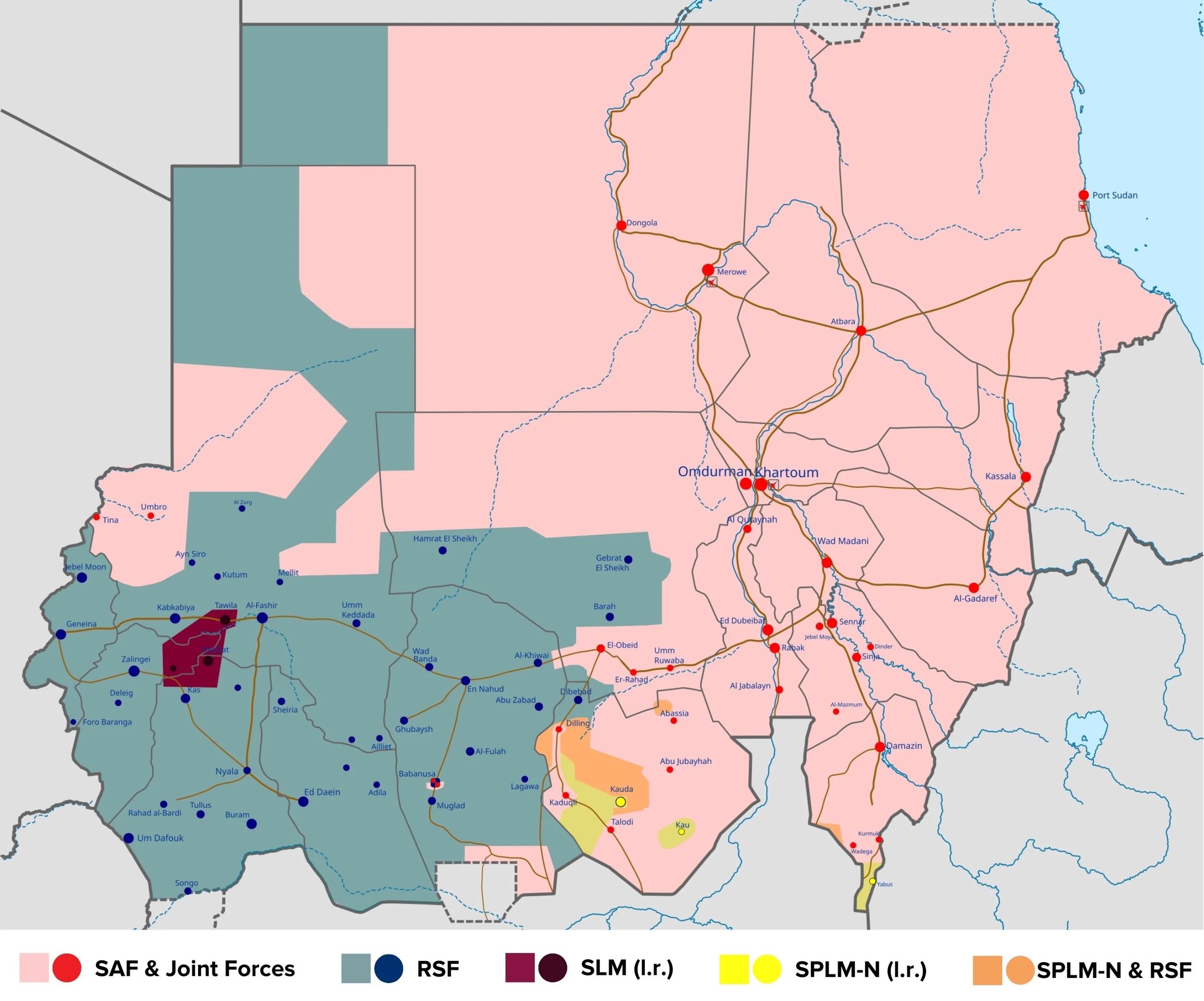
Map: Click or tap to expand. (source)
Zooming out, once the RSF feels that El Fasher is firmly under its tyrannical control, many of its fighters will likely be deployed north and east to the main battle lines. In recent months the army has struggled to advance toward the Darfur provinces and even lost minimal ground the past few weeks. The arrival of thousands of battle-hardened RSF fighters from El Fasher to the front lines will almost certainly set the army back even further.
The army’s leadership is again facing mounting frustration that had subsided some earlier in the year, when army troops captured Khartoum and made a significant push westward. With battlefield progress once again stalled and the army losing another major city to the RSF, questions about General Buhran’s ability to lead the army are likely to resurface. Ongoing frustration could easily give way to unexpected changes in the army itself, some of which could be bloody, unless the army can shift the tide of the war again.
Altogether and put simply, the war and humanitarian crisis still have no end in sight. And the worst may still lie ahead.
This massacre was preventable
And what of the Sudanese who manage to escape the genocide in El Fasher? Most all will face the pangs of hunger and preventable illness wherever they go. International aid is only 27% funded for all of 2025 and the year is almost over. The refugee camps in eastern Chad are overwhelmed. Those reaching Tawila in the heart of Darfur are finding safety, but few medical and humanitarian services. As has been the case throughout this war, another stage of the humanitarian crisis is brewing from another round of senseless carnage.
The international community had ample time and warning to intervene by air and on the ground in El Fasher, either through the forceful delivery of aid or even more aggressive measures. Indeed, what we are seeing in El Fasher is one of the most predicted genocides in modern history. It has been well over a year since the United Nations Security Council passed a resolution demanding that the RSF end its siege of El Fasher and allow for aid access. RSF commanders ignored these hollow words. The political will never emerged to prevent the massacres that are now unfolding in El Fasher, and there is still a lack of will to provide mere humanitarian aid to survivors.
The promise of “never again” when it comes to genocide is being broken by world leaders yet again. It now falls to ordinary citizens to do what we can to save and change lives for the better.
How you can help
Our free global event turns everyday runs, bike rides, and walks into lifesaving support. Every mile you put in and dollar you raise helps fund emergency aid, healthcare, and education programs led by Sudanese heroes. We also have an option where you can skip the exercise and just fundraise. Every dollar raised makes a difference. Donations are being matched for a limited time!
Checks can be made payable to Operation Broken Silence and mailed to PO Box 770900 Memphis, TN 38177-0900. You can also donate stock or crypto. Operation Broken Silence a 501(c)(3) nonprofit organization. Donations are tax-deductible within the guidelines of U.S. law. Our EIN is 80-0671198.
Shareables
Short statements you can share online and with others. Simply copy and paste.
Share Our Posts: Instagram | Facebook | Threads | Bluesky | Reddit | LinkedIn
The besieged capital of North Darfur and last army stronghold in western Sudan fell to the Rapid Support Forces on October 26-27. The resulting massacre is being committed at such breakneck speed that bodies and bloodstained soil can be seen by satellites. https://operationbrokensilence.org/blog/thousands-murdered-as-el-fasher-falls-to-rapid-support-forces
A fast-paced genocide is unfolding in the city of El Fasher, Sudan. It’s estimated over 3,000 Sudanese have already been killed. The actual death toll is likely far higher. https://operationbrokensilence.org/blog/thousands-murdered-as-el-fasher-falls-to-rapid-support-forces
Multiple satellite images show “dark colored objects consistent with the size of human bodies” with “reddish ground discoloration” underneath in areas where the RSF is running house-to-house clearance operations. Translation: these are massacre sites with clusters of bodies and bloodstained soil. https://operationbrokensilence.org/blog/thousands-murdered-as-el-fasher-falls-to-rapid-support-forces
Sudanese in El Fasher were always going to be on borrowed time without a major and sustained outside intervention by either the army or international community. That intervention never came, deepening fears that when the RSF did capture the city, the genocidal paramilitary force would engage in a localized massacre on a scale unprecedented in our time. https://operationbrokensilence.org/blog/thousands-murdered-as-el-fasher-falls-to-rapid-support-forces
Operation Broken Silence is dedicated to Sudanese communities, cultivating resilience and driving meaningful change through crowdfunded programs. Will you join us? https://operationbrokensilence.org/blog/thousands-murdered-as-el-fasher-falls-to-rapid-support-forces

Letter to Representative Chris Smith concerning genocide emergency in El Fasher
Operation Broken Silence is joining over 30 organizations in urging Representative Chris Smith, a long-time advocate and friend to the Sudanese people, to bring the urgent situation in Sudan to the White House.
Representative Chris Smith (U.S. House of Representatives)
Operation Broken Silence is joining over 30 organizations in urging Representative Chris Smith, a long-time advocate and friend to the Sudanese people, to bring the urgent situation in Sudan to the White House.
Sudan is home to the world’s largest humanitarian catastrophe. The country is collapsing after two and a half years of brutal warfare between the Sudanese Armed Forces (SAF) and the Rapid Support Forces (RSF). Neighborhoods in Khartoum lie in ruins. In Darfur, entire communities have already been wiped out by RSF-led violence. Families are fleeing with nothing but the clothes on their backs. Famine is spreading, and access to basic healthcare is disappearing.
There is perhaps no other place more dangerous in Sudan than El Fasher in North Darfur. The city has been surrounded by the RSF for 16 months, and the nearby displacement camps are now largely destroyed after months of extreme shelling and RSF killings. Defending El Fasher is the army’s 6th Infantry Division, surviving Darfuri rebels from the 2000s genocide, pro-army militias, and volunteer Zaghawa fighters trying to protect their people. The United Nations estimates at least 260,000 Sudanese citizens are still trapped in the area, nearly half of which are children.
It is widely expected that if the RSF overruns the Greater El Fasher area, the genocidal paramilitary force will engage in a massacre on a scale unprecedented in the 21st century.
Many residents and displaced people here belong to ethnic African groups like the Zaghawa and Fur that the predominantly Arab RSF is openly targeting for annihilation. A sizable portion of the RSF rank and file adheres to an extremely racist, Arab-supremacist ideology that seeks to ethnically cleanse Darfur of African tribal groups and claims all other Sudanese Arabs are inferior.
The international community has now had 16 months to take decisive action on the genocide emergency in El Fasher, and Sudan more broadly. What little progress that was being made was due to American policy under the Biden Administration. That has since ended under the Trump Administration. There is still no US Special Envoy for Sudan and USAID-backed programs in Sudan have been gutted.
Today, security conditions in El Fasher are rapidly worsening. It is all but certain that the RSF will overrun the city in the next few weeks, if not sooner. This situation was preventable. At any point in the last 16 months the international community could have taken decisive action to get more food and medicine into the city, as well as reduce the free flow of weapons to the RSF, weapons that have allowed this siege to continue. World leaders chose not to act. Tens of thousands of lives hang by a thread because of it.
In what are likely these final days for El Fasher as it has long been known, there is still time to act. We hope Representative Smith once again raises his voice to the highest levels of American government on behalf of the Sudanese people. There is still time to stave off the looming massacre.
Get Involved
Our free global event turns everyday runs, bike rides, and walks into lifesaving support. Every mile you put in and dollar you raise helps fund emergency aid and long-term education programs led by Sudanese heroes. Not a fan of fitness? We have an option where you can skip the moving and just fundraise. Every dollar raised still makes a difference. Donations are being matched for a limited time!
Checks can be made payable to Operation Broken Silence and mailed to PO Box 770900 Memphis, TN 38177-0900. You can also donate stock or crypto. Operation Broken Silence a 501(c)(3) nonprofit organization. Our EIN is 80-0671198. Donations are tax-deductible within the guidelines of U.S. law.
Shareables
Short statements you can share online and with others. Simply copy and paste.
Share Our Posts: Instagram | Facebook | Threads | Bluesky | Reddit | LinkedIn
Operation Broken Silence is joining over 30 organizations in urging Representative Chris Smith, a long-time advocate and friend to the Sudanese people, to bring the urgent situation in Sudan to the White House. https://operationbrokensilence.org/blog/letter-to-representative-chris-smith-concerning-genocide-emergency-in-el-fasher
Sudan is home to the world’s largest humanitarian catastrophe. The country is collapsing after two and a half years of brutal warfare between the Sudanese Armed Forces and the Rapid Support Forces. https://operationbrokensilence.org/blog/letter-to-representative-chris-smith-concerning-genocide-emergency-in-el-fasher
It is widely expected that if the Rapid Support Forces overrun the Greater El Fasher area, the genocidal paramilitary force will engage in a massacre on a scale unprecedented in the 21st century. https://operationbrokensilence.org/blog/letter-to-representative-chris-smith-concerning-genocide-emergency-in-el-fasher
Operation Broken Silence is dedicated to Sudanese communities, cultivating resilience and driving meaningful change through crowdfunded programs. Will you join us? https://operationbrokensilence.org/blog/letter-to-representative-chris-smith-concerning-genocide-emergency-in-el-fasher
Hard evidence emerges of chemical weapons attacks in Sudan
Rumors of chemical weapons being deployed have persisted throughout this war.
The U.S. State Department announced in May 2025 that the Sudanese army had used chemical weapons in the current war. This announcement came with no details about which chemical agents were used by the army, or where and at what scale, except that such weapons were deployed in 2024.
Sudan is home to the world largest humanitarian emergency, sparked by one of the worst armed conflicts in modern history. Fighting between the army and Rapid Support Forces (RSF), a rogue paramilitary force wielding tremendous firepower, has left Khartoum in ruins. In the oppressed western Darfur region, entire communities are being annihilated by the RSF. Villages are burning, crops are rotting in the fields, and families are fleeing with nothing but the clothes on their backs. And it’s hardly ever in the news.
Sudan Crisis Guide
Trying to make sense of the war in Sudan? We’ll get you up to speed in a few minutes.
Rumors of chemical weapons being deployed in Sudan have persisted throughout this war, as well as for decades before. The United States bombed an industrial plant in Khartoum in 1998 that it said was processing a VX nerve agent, a claim that came under serious question in the aftermath.
A substantial 2016 investigation by Amnesty International found credible evidence that chemical weapons had been used to kill and maim hundreds of Sudanese in Darfur, including children. Anecdotal accounts have leaked out of the oppressed Nuba Mountains and Blue Nile regions for years as well, often with fleeing refugees who saw strange, gaseous munitions explode.
Now a new investigation by France 24’s Observers team provides the first public evidence to corroborate the State Department’s allegations, indicating that Sudan’s army likely used chlorine gas in September 2024:
Using open-source investigation techniques (OSINT), the FRANCE 24 Observers team in Paris examined two incidents in September 2024 in and near the al-Jaili oil refinery, north of Khartoum, which the army was attempting to recapture from the RSF. After reviewing images of the attacks gathered by the Observers, five experts confirmed they were consistent with aerial drops of chlorine barrels. Only the Sudanese army possesses the aircraft needed for such bombardments.
The Observers team also traced the origin of one of the chlorine barrels used in the attacks. Imported from India by a Sudanese company that provides supplies to the Sudanese army, the chlorine was intended, according to the Indian exporter, “solely for treatment of drinking water”. Chlorine is a much-needed humanitarian product in Sudan, critical for purifying water in a country prone to cholera outbreaks.
The military use of chlorine would place Sudan among the few regimes to have deployed this rudimentary lethal gas since World War I, during which it was used on a large scale.
What is chlorine gas?
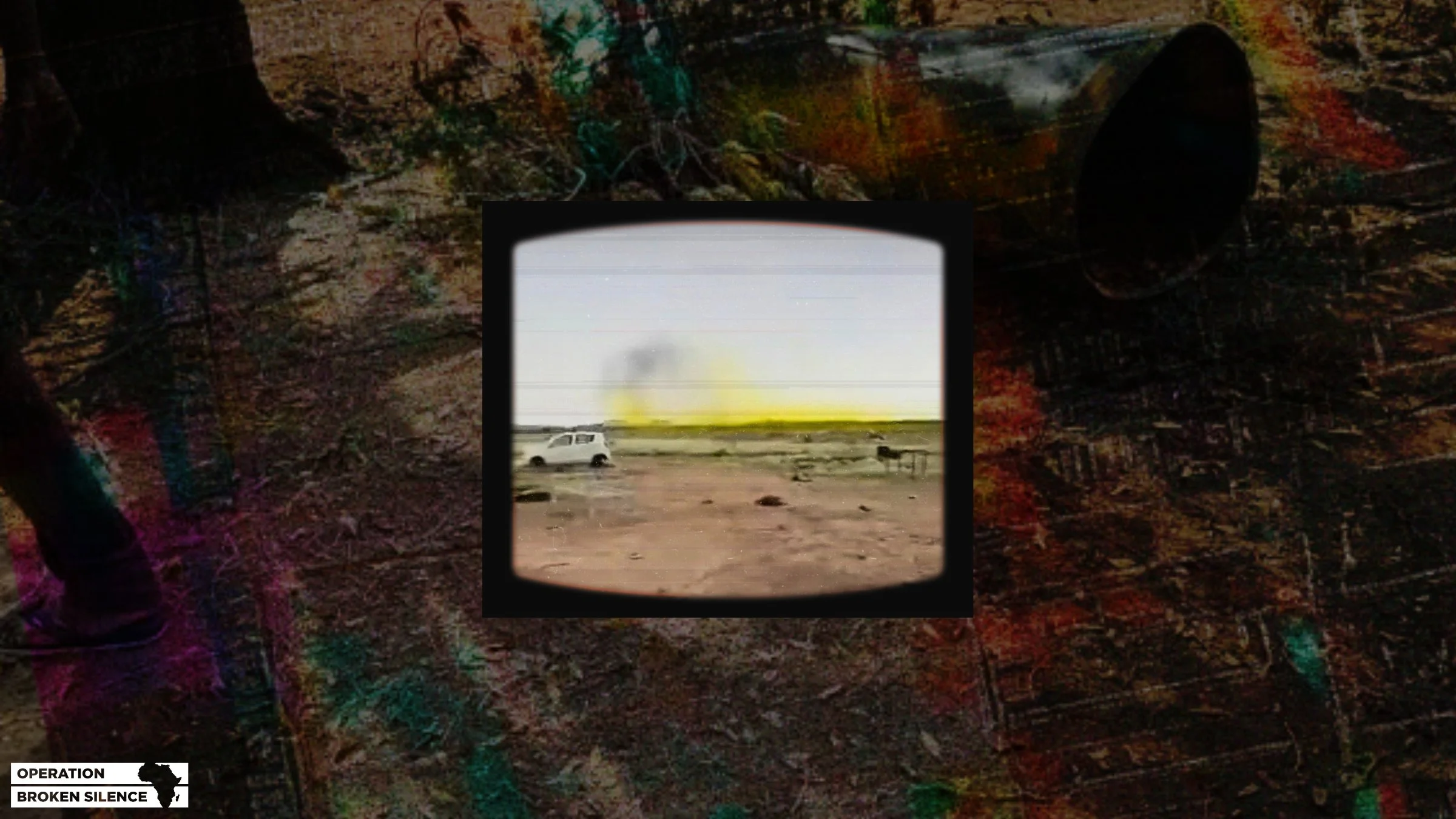
According to Physicians for Human Rights, chlorine gas is a pulmonary irritant with intermediate water solubility that causes acute damage in the upper and lower respiratory tract. At room temperature, it is a dense, yellow-green gas that settles along the ground. Chlorine gas causes oral, nasal, and ocular discomfort that serves as a warning property to get out of the area of exposure and limit pulmonary damage, which may occur with prolonged exposure. Chlorine gas turns to hydrochloric acid when it makes contact with moisture in airways; it then causes chemical burns to all respiratory tissue it contacts.

Screengrab from a video posted to a pro-RSF account in May 2025 and geolocated to the Barri military base, shows a yellow-green cloud characteristic of chlorine.
Exposure to chlorine gas can lead to diverse symptoms that are as mild as itchiness to shortness of breath to as severe as death. In the France 24 report, chemical weapons specialist Dan Kaszeta said of these specific attacks in Sudan:
“The symptoms of chlorine gas exposure are relatively generic, with few clearly identifiable signs. In reality, it is very difficult to kill someone with this gas when it is dispersed in the open air, in this way. It is mostly used as a strong irritant, to force opponents out of shelters and make them vulnerable to conventional bombardment.”
From another part of the France 24 report:
The Observers spoke with a former engineer who was inside the refinery on September 13, along with many other workers. For his safety, his name has been withheld. Now living abroad, he provided evidence of his employment at the al-Jaili refinery, as well as screenshots showing that he had reported the incident to contacts on the morning of September 13. By phone, he said:
“It was early, around 8am. I was in my room, where we were housed. I heard a plane coming, and then there was a huge noise, like something falling. I went outside with two friends, and I saw a lot of smoke. Luckily I wasn’t near the zone. After 30 minutes, we went to see the place where the projectiles had fallen. The people near them were unconscious, or having trouble breathing, and coughing. We helped them, with the security staff, and took them to the refinery’s clinic.”
The engineer’s account is consistent with the images and witness statements posted online. He also said that some of the victims died after the incident. The Observers team was unable to confirm this allegation, and no other sources mention any deaths in connection with the two incidents.
Weaponized chlorine is prohibited under the Chemical Weapons Convention, to which Sudan is a member. The use of “asphyxiating, poisonous or other gases” on battlefields is also classified as a war crime under the Rome Statute of the International Criminal Court.
Confirming army responsibility
While no images of army aircraft dropping chlorine barrels has emerged, just the immediate aftermath, it is well known that the army is the only force inside Sudan with the aerial capacity to drop chlorine barrels of this size.
The RSF only has drones for aerial bombing, which are not capable of carrying barrels this heavy. Cargo planes have been spotted in RSF-held areas of Sudan, especially at Nyala airport in South Darfur, but it is generally known these planes are delivering weapons to the RSF, likely from the United Arab Emirates. No documentation, imagery, or eyewitness accounts exist of the RSF conducting airstrikes with planes or helicopters. Sudan’s other smaller rebel, paramilitary, and militia groups have little to no air capacity at all.
That leaves the army. It’s also worth noting at the reported time of these likely chlorine attacks, the army had been battling to recapture the al-Jaili facility from the RSF for months. Although chlorine gas has rarely been deployed since WWI, its use as a weapon to try to “flush out” entrenched combatants matches the army’s combat objectives at the time. The army has repeatedly denied
What does all this mean for Sudan’s present situation? The widespread and heavy use of conventional munitions in areas of combat shows the war will continue with or without chemical weapons and continue to be immensely destructive. Still, the use of chemical weapons is just the latest reminder that, even with how bad the situation in Sudan already is, things can still get much worse. Reductions of violence and more humanitarian aid in any and all forms can save many lives, even if the war itself continues.
How you can help
Our free global event turns everyday runs, bike rides, and walks into lifesaving support. Every mile you put in and dollar you raise helps fund emergency aid and long-term education programs led by Sudanese heroes. Not a fan of fitness? We have an option where you can skip the moving and just fundraise. Every dollar raised still makes a difference. Donations are being matched for a limited time!
Checks can be made payable to Operation Broken Silence and mailed to PO Box 770900 Memphis, TN 38177-0900. You can also donate stock or crypto. Operation Broken Silence a 501(c)(3) nonprofit organization. Donations are tax-deductible within the guidelines of U.S. law. Our EIN is 80-0671198.
Shareables
Short statements you can share online and with others. Simply copy and paste.
Share Our Posts: Instagram | Facebook | Threads | Bluesky | Reddit | LinkedIn
A new investigation provides the first public evidence of chemical weapons usage on Sudan’s battlefields, indicating the national army likely used chlorine gas in September 2024. https://operationbrokensilence.org/blog/hard-evidence-emerges-of-chemical-weapons-attacks-in-sudan
Rumors of chemical weapons being deployed in Sudan have persisted throughout this war, as well as for decades before. https://operationbrokensilence.org/blog/hard-evidence-emerges-of-chemical-weapons-attacks-in-sudan
The military use of chlorine would place Sudan among the few regimes to have deployed this rudimentary lethal gas since World War I, during which it was used on a large scale. https://operationbrokensilence.org/blog/hard-evidence-emerges-of-chemical-weapons-attacks-in-sudan
While no images of army aircraft dropping chlorine barrels has emerged, just the immediate aftermath, it is well known that the army is the only force inside Sudan with the aerial capacity to drop chlorine barrels of this size. https://operationbrokensilence.org/blog/hard-evidence-emerges-of-chemical-weapons-attacks-in-sudan
Operation Broken Silence is dedicated to Sudanese communities, cultivating resilience and driving meaningful change through crowdfunded programs. Will you join us? https://operationbrokensilence.org/blog/hard-evidence-emerges-of-chemical-weapons-attacks-in-sudan

Chalkboards delivered to schools in Yida Refugee Camp
The war in Sudan has decimated childhood education. Across the border in Yida Refugee Camp, we’re still doing our small part to help.


The war in Sudan has decimated childhood education. Across the border in Yida Refugee Camp, we’re still doing our small part to help.
•••••
Today, across Sudan, children are experiencing an education crisis unparalleled in recent history. Most schools have closed from the war, and it’s estimated over 19 million children are out of a classroom. Many may never have the chance to return. Refugee camps like Yida are some of the only places where Sudanese children can safely access education right now.
But even in the camps support for education is scarce due to a veil of silence around these problems. With crises raging in the Middle East and Ukraine, as well as as political turmoil in the United States, there are few Sudan-minded donors today, and even fewer concerned about childhood education.
The good news is that last week our partner River Nile Ministries was able to deliver 40 chalkboards to the education office in Yida. All the schools here are severely under-resourced. Providing basic materials like chalkboards may not sound super exciting, but it’s helpful for teachers and students who are struggling to forge a better path.
This couldn’t have been possible without your support! Your generosity today helps build stronger classrooms —and brighter futures— for Sudanese children who have already overcome so much.
Checks can be made payable to Operation Broken Silence with Education written in the memo line and mailed to PO Box 770900 Memphis, TN 38177-0900. You can also donate stock or crypto. Operation Broken Silence a 501(c)(3) nonprofit organization. Donations are tax-deductible within the guidelines of U.S. law. Our EIN is 80-0671198.
Shareables
Short statements you can share online and text to others. Simply copy and paste.
The war in Sudan has decimated childhood education. Across the border in Yida Refugee Camp, we’re still doing our small part to help. https://operationbrokensilence.org/blog/chalkboards-delivered-to-schools-in-yida-refugee-camp
Even in the camps support for education is scarce due to a veil of silence around these problems. With crises raging in the Middle East and Ukraine, as well as as political turmoil in the United States, there are few Sudan-minded donors today, and even fewer concerned about childhood education. https://operationbrokensilence.org/blog/chalkboards-delivered-to-schools-in-yida-refugee-camp
Good news! Last week our education partner was able to deliver 40 chalkboards to other schools in Yida. Learn more: https://operationbrokensilence.org/blog/chalkboards-delivered-to-schools-in-yida-refugee-camp
Operation Broken Silence is dedicated to Sudanese communities, cultivating resilience and driving meaningful change through crowdfunded programs. Will you join us? https://operationbrokensilence.org/blog/chalkboards-delivered-to-schools-in-yida-refugee-camp
What Is Genocide?
Genocide is an internationally recognized crime where acts are committed with the intent to destroy, in whole or in part, a national, ethnic, racial, or religious group.
This is a brief article providing a contextual background for understanding the issues Operation Broken Silence works on. It is part of our resource list for students, teachers, and the curious and was last updated October 2025.
Genocide is an internationally recognized crime where acts are committed with the intent to destroy, in whole or in part, a national, ethnic, racial, or religious group. These acts fall into five categories:
Killing members of the group
Causing serious bodily or mental harm to members of the group
Deliberately inflicting on the group conditions of life calculated to bring about its physical destruction in whole or in part
Imposing measures intended to prevent births within the group
Forcibly transferring children of the group to another group

Photo: Raphael Lemkin (Wikimedia Commons)
Origin of the Term
In 1944, Polish-Jewish lawyer Raphael Lemkin created the term genocide. He formed the word by combining geno-, from the Greek word for race or tribe, with -cide, from the Latin word for killing. He included the term in his book that documented Nazi policies of the systematic destruction of national and ethnic groups, notably the mass murder of European Jews.
Lemkin defined genocide as "a coordinated plan of different actions aiming at the destruction of essential foundations of the life of national groups, with the aim of annihilating the groups themselves."
In 1945, the International Military Tribunal — held at Nuremberg, Germany — charged top Nazi officials with crimes against humanity. Lemkin’s term genocide was included in the indictments, but only as a descriptive term, not a legal one.
On December 9, 1948, the United Nations approved the Convention on the Prevention and Punishment of the Crime of Genocide. This codified the term genocide in international law, defining it in Article II of the Convention as outlined above.
Further Development of the Term & Research
From an academic and legal perspective, the development of the term genocide is usually placed into two historical periods:
1944-1948: the coining of the term through its acceptance as international law
1991-1998: the establishment of international criminal tribunals created to prosecute the crime of genocide
Throughout history, there have been many cases of targeted violence against various groups of people. Many of these were committed before the term genocide was created and codified into international law. In his work, Lemkin thoughtfully wrote that the term genocide did not create a new phenomenon, but rather was "an old practice in its modern development."
Many scholars have pointed back to campaigns of mass killings that were committed before the 1940s as historical examples of genocide, despite a reputable court of law or tribunal not ruling that genocide was committed. After additional research and recognitions by various governing bodies, some of these pre-1940s campaigns are now widely accepted to have been genocides. One of the most notable example was the systematic mass murder and expulsion of ethnic Armenians committed by the Ottoman government during World War I. Lemkin pointed to the crimes committed against ethnic Armenians as an example of what he meant by the term genocide.
Since the crime of genocide was codified into international law in 1948, various governments and civil and international institutions have researched how and why genocides are committed, as well as how they can be prevented and brought to an end. Perhaps the most well-known result of this critical work is The 10 Stages of Genocide, a processual model that aims to demonstrate how genocides progress. It is widely accepted as a helpful tool for understanding the mechanics of past genocides, as well as providing early warning signs that can be used to prevent future genocides and other mass atrocities. It also provides preventive measures that can be used to prevent, slow, or stop the process.
From Learning To Action
Our free global event turns everyday runs, bike rides, and walks into lifesaving support. Every mile you put in and dollar you raise helps fund emergency aid, healthcare, and education programs led by Sudanese heroes. We also have an option where you can skip the exercise and just fundraise. Every dollar raised makes a difference.
Checks can be made payable to Operation Broken Silence and mailed to PO Box 770900 Memphis, TN 38177-0900. You can also donate stock or crypto. Operation Broken Silence a 501(c)(3) nonprofit organization. Donations are tax-deductible within the guidelines of U.S. law. Our EIN is 80-0671198.
The 10 Stages Of Genocide
Genocide doesn't just happen in a vacuum. It is a crime that follows a largely predictable process.

Photo: Auschwitz II-Birkenau, a former Nazi concentration and extermination camp. Roughly 90% of the more one million victims of Auschwitz Concentration Camp died in Birkenau. More than nine out of every ten were Jews. A large proportion of the more than 70,000 Poles who died or were killed in the Auschwitz complex perished in Birkenau, as did approximately 20,000 Roma and Sinti, in addition to Soviet POWs and prisoners of other nationalities. (Canva Pro)
This is a brief article providing a contextual background for understanding the issues Operation Broken Silence works on. It is part of our resource list for students, teachers, and the curious and was last updated October 2025.
The 10 Stages of Genocide is a processual model that aims to demonstrate how the crime of genocide is committed. It is widely accepted as a helpful tool for understanding the mechanics of past genocides, as well as providing early warning signs that can be used to prevent future genocides and other mass atrocity crimes. It also provides preventive measures that can be used to prevent, slow, or stop the process.

Dr. Gregory Stanton (Genocide Watch)
Origin of the Model
This system was designed by Dr. Gregory Stanton, who has been deeply engaged in genocide prevention and justice efforts in governmental, academic, and civil society institutions since the 1980s.
Dr. Stanton best described how to use the 10 Stages of Genocide model. He wrote:
“No model is ever perfect. All are merely ideal-typical representations of reality that are meant to help us think more clearly about social and cultural processes. It is important not to confuse any stage with a status. Each stage is a process. It is like a fluctuating point on a thermometer that rises and falls as the social temperature in a potential area of conflict rises and falls. It is crucial not to confuse this model with a linear one. In all genocides, many stages occur simultaneously.”
Stage 1: Classification
All cultures have categories to distinguish people into “us and them” by ethnicity, race, religion, or nationality: German and Jew, Hutu and Tutsi. Bipolar societies that lack mixed categories, such as Rwanda and Burundi, are the most likely to have genocide.
One of the most important classifications in the current nation-state system is citizenship in a nationality. Removal or denial of a group's citizenship is a legal way to deny the group's civil and human rights. The first step toward the genocide of Jews and Roma in Nazi Germany were the laws to strip them of their German citizenship. Burma's 1982 citizenship law classified Rohingyas out of national citizenship. In India, the Citizenship Act denies a route to citizenship for Muslim refugees. Native Americans were not granted citizenship in the USA until 1924, after centuries of genocide that decimated their populations.
The main preventive measure at this early stage is to develop universalistic institutions that transcend ethnic or racial divisions, that actively promote tolerance and understanding, and that promote classifications that transcend the divisions. The Catholic church could have played this role in Rwanda, had it not been riven by the same ethnic cleavages as Rwandan society.
Promotion of a common language in countries like Tanzania has also promoted transcendent national identity. Laws that provide routes for citizenship to immigrants and refugees break down barriers to civil rights. This search for common ground is vital to early prevention of genocide.
Stage 2: Symbolization
We give names or other symbols to the classifications. We name people “Jews” or “Roma”, or distinguish them by colors or dress; and apply the symbols to members of groups. Classification and symbolization are universally human and do not necessarily result in genocide unless they lead to dehumanization.
When combined with hatred, symbols may be forced upon unwilling members of pariah groups: the yellow star for Jews under Nazi rule, the blue scarf for people from the Eastern Zone in Khmer Rouge Cambodia.
To combat symbolization, hate symbols can be legally forbidden (swastikas) as can hate speech. Group marking like gang clothing or tribal scarring can be outlawed, as well. The problem is that legal limitations will fail if unsupported by popular cultural enforcement. Though Hutu and Tutsi were forbidden words in Burundi until the 1980’s, code words replaced them.
If widely supported, denial of symbolization can be powerful, as it was in Bulgaria, where the government refused to supply enough yellow badges and at least 80% of Jews did not wear them, depriving the yellow star of its significance as a Nazi symbol for Jews.
Stage 3: Discrimination
A dominant group uses law, custom, and political power to deny the rights of other groups. The powerless group may not be accorded full civil rights, voting rights, or even citizenship.
The dominant group is driven by an exclusionary ideology that would deprive less powerful groups of their rights. The ideology advocates monopolization or expansion of power by the dominant group. It legitimizes the victimization of weaker groups. Advocates of exclusionary ideologies are often charismatic, expressing the resentments of their followers. Examples include the Nuremberg Laws of 1935 in Nazi Germany, which stripped Jews of their German citizenship, and prohibited their employment by the government and by universities. Discrimination against Native and African-Americans was enshrined in the US Constitution until the post-Civil War Amendments and mid-20th century laws to enforce them. Denial of citizenship to the Rohingya Muslim minority in Myanmar led to genocide in 2017 and the displacement of over a million refugees.
Prevention against discrimination means full political empowerment and citizenship rights for all groups in a society. Discrimination on the basis of nationality, ethnicity, race or religion should be outlawed. Individuals should have the right to sue the state, corporations, and other individuals if their rights are violated.
Stage 4: Dehumanization
One group denies the humanity of the other group. Members of it are equated with animals, vermin, insects or diseases.
Dehumanization overcomes the normal human revulsion against murder. At this stage, hate propaganda in print, on hate radios, and in social media is used to vilify the victim group. It may even be incorporated into school textbooks. Indoctrination prepares the way for incitement.
The majority group is taught to regard the other group as less than human, and even alien to their society. They are indoctrinated to believe that “we are better off without them.” The powerless group can become so depersonalized that they are numbers rather than names, as Jews were in the death camps. They are equated with filth, impurity, and immorality. Hate speech fills the propaganda of official radio, newspapers, and speeches.
To combat dehumanization, incitement to genocide should not be confused with protected speech. Genocidal societies lack constitutional protection for countervailing speech and should be treated differently than democracies. Local and international leaders should condemn the use of hate speech and make it culturally unacceptable.
Leaders who incite genocide should be prosecuted in national courts. They should be banned from international travel and have their foreign finances frozen. Hate radio stations should be jammed or shut down, and hate propaganda and its sources banned from social media and the internet. Hate crimes and atrocities should be promptly punished.
Stage 5: Organization
Genocide is always organized, usually by the state, often using militias to provide deniability of state responsibility (the Janjaweed in Darfur). Sometimes organization is informal (Hindu mobs led by local RSS militants) or decentralized (terrorist groups).
Special army units or militias are often trained and armed. Plans are made for genocidal killings. Genocide often occurs during civil or international wars. Arms flows to states and militias (even in violation of UN Arms Embargoes) facilitate acts of genocide. States organize secret police to spy on, arrest, torture, and murder people suspected of opposition to political leaders.
Motivations for targeting a group are indoctrinated through mass media and special training for murderous militias, death squads, and special army killing units like the Nazi Einsaztgruppen, which murdered 1.5 million Jews in Eastern Europe.
To combat organization, membership in genocidal militias should be outlawed. Their leaders should be denied visas for foreign travel and their foreign assets frozen. The UN should impose arms embargoes on governments and citizens of countries involved in genocidal massacres, and create commissions to investigate violations, as was done in post-genocide Rwanda. National legal systems should prosecute and disarm groups that plan and commit hate crimes.
Stage 6: Polarization
Extremists drive the groups apart. Hate groups broadcast polarizing propaganda. Laws may forbid intermarriage or social interaction.
Extremist terrorism targets moderates, intimidating and silencing the center. Moderates from the perpetrators’ own group are most able to stop genocide, so are the first to be arrested and killed. Leaders in targeted groups are the next to be arrested and murdered.
The dominant group passes emergency laws or decrees that grants them total power over the targeted group. The laws erode fundamental civil rights and liberties. Targeted groups are disarmed to make them incapable of self-defense, and to ensure that the dominant group has total control.
Prevention may mean security protection for moderate leaders or assistance to human rights groups. Assets of extremists should be seized, and visas for international travel denied to them. Coups d’état by extremists should be opposed by international sanctions and regional isolation of extremist leaders. Vigorous objections should be raised to arrests of members of opposition groups. If necessary, targeted groups should be armed to defend themselves. National government leaders should denounce polarizing hate speech. Educators should teach tolerance.
Stage 7: Preparation
National or perpetrator group leaders plan the “Final Solution” to the Jewish, Armenian, Tutsi or other targeted group “question.” They often use euphemisms to cloak their intentions, such as referring to their goals as “ethnic cleansing,” “purification,” or “counter-terrorism.”
They build armies, buy weapons and train their troops and militias. They indoctrinate the populace with fear of the victim group. Leaders often claim that “if we don’t kill them, they will kill us,” disguising genocide as self-defense. There is a sudden increase in inflammatory rhetoric and hate propaganda with the objective of creating fear of the other group.
Political processes such as peace accords that threaten the dominance of the ruling group through elections or prosecution for corruption may actually trigger genocide.
Prevention of preparation may include arms embargoes and commissions to enforce them. It should include prosecution of incitement and conspiracy to commit genocide, both crimes under Article 3 of the Genocide Convention.
National law enforcement authorities should arrest and prosecute leaders of groups planning genocidal massacres.
Stage 8: Persecution
Victims are identified and separated out because of their national, ethnic, racial, or religious identity. The victim group’s most basic human rights are systematically violated through extrajudicial killings, torture, and forced displacement. Death lists are drawn up.
In state-sponsored genocide, members of victim groups may be forced to wear identifying symbols. Their property is often expropriated. Sometimes they are segregated into ghettoes, deported to concentration camps, or confined to a famine-struck region and starved. They are deliberately deprived of resources such as water or food in order to slowly destroy the group. Programs are implemented to prevent procreation through forced sterilization or abortions. Children are forcibly taken from their parents.
Genocidal massacres begin. All of these are acts of genocide outlawed by the Genocide Convention. They are acts of genocide because they intentionally destroy part of a group.
The perpetrators watch for whether such massacres are opposed by any effective international response. If there is no reaction, they realize they can get away with genocide. The perpetrators know that the UN, regional organizations, and more powerful nations will again be bystanders and permit genocide.
At this stage, a Genocide Emergency must be declared. If the political will of great powers, regional alliances, or UN Security Council or General Assembly can be mobilized, vigorous diplomacy, targeted economic sanctions, and even armed international intervention should be prepared. Assistance should be provided to the victim group to prepare for its self-defense. Humanitarian assistance should be organized by the UN and private relief groups for the inevitable tide of refugees to come.
Stage 9: Extermination
Extermination begins and quickly becomes the mass killing legally called “genocide.” It is “extermination” to the killers because they do not believe their victims to be fully human.
When it is sponsored by the state, the armed forces often work with militias to do the killing.
The goal of total genocides is to kill all the members of the targeted group. But most genocides are genocides "in part." All educated members of the targeted group might be murdered (Burundi 1972). All men and boys of fighting age may be murdered (Srebrenica, Bosnia 1995). All women and girls may be raped (Darfur, Myanmar.) Mass rapes of women have become a characteristic of all modern genocides. Rape is used as a means to genetically alter and destroy the victim group.
Sometimes the genocide results in revenge killings by groups against each other, creating the downward whirlpool-like cycle of bilateral genocide (as in Burundi). Destruction of cultural and religious property is employed to annihilate the group’s existence from history (Armenia 1915 - 1922, Da'esh/ISIS 2014 - 2018).
“Total war” between nations or ethnic groups is inherently genocidal because it does not differentiate civilians from non-combatants. "Carpet" bombing, firebombing, bombing hospitals, and use of chemical or biological weapons are war crimes and also acts of genocide. Terrorism does not differentiate civilians and combatants, and when intended to destroy members of a national, ethnic, racial, or religious group is genocidal. Use of nuclear weapons is the ultimate act of genocide because it is consciously intended to destroy a substantial part of a national group.
During active genocide, only rapid and overwhelming armed intervention can stop genocide. Real safe areas or refugee escape corridors should be established with heavily armed international protection. (An unsafe “safe” area is worse than none at all.)
For armed interventions, a multilateral force authorized by the UN should intervene if politically possible. The Standing High Readiness Brigade, EU Rapid Response Force, or regional forces (NATO, ASEAN, ECOWAS) — should be authorized to act by the UN Security Council.
The UN General Assembly may authorize action under the Uniting for Peace Resolution G A Res. 330 (1950), which has been used 13 times for such armed intervention.
If the UN is paralyzed, regional alliances must act under Chapter VIII of the UN Charter. The international responsibility to protect transcends the narrow interests of individual nation states. If strong nations will not provide troops to intervene directly, they should provide the airlift, equipment, and financial means necessary for regional states to intervene.
Stage 10: Denial
Denial is the final stage that lasts throughout and always follows genocide. It is among the surest indicators of further genocidal massacres.
The perpetrators of genocide dig up the mass graves, burn the bodies, try to cover up the evidence, and intimidate the witnesses. They deny that they committed any crimes, and often blame what happened on the victims. Acts of genocide are disguised as counter-insurgency if there is an ongoing armed conflict or civil war.
Perpetrators block investigations of the crimes, and continue to govern until driven from power by force, when they flee into exile. There they remain with impunity, like Pol Pot or Idi Amin, unless they are captured and a tribunal is established to try them.
During and after genocide, lawyers, diplomats, and others who oppose forceful action often deny that these crimes meet the definition of genocide. They call them euphemisms like "ethnic cleansing" instead. They question whether intent to destroy a group can be proven, ignoring thousands of murders. They overlook deliberate imposition of conditions that destroy part of a group. They claim that only courts can determine whether there has been genocide, demanding "proof beyond a reasonable doubt," when prevention only requires action based on compelling evidence.
The best response to denial is punishment by an international tribunal or national courts. There the evidence can be heard and the perpetrators punished. Tribunals like the Yugoslav, Rwanda or Sierra Leone Tribunals, the tribunal to try the Khmer Rouge in Cambodia, or the International Criminal Court may not deter the worst genocidal killers. But with the political will to arrest and prosecute them, some may be brought to justice. Local justice and truth commissions and public school education are also antidotes to denial. They may open ways to reconciliation and preventive education.
From Learning To Action
Our free global event turns everyday runs, bike rides, and walks into lifesaving support. Every mile you put in and dollar you raise helps fund emergency aid, healthcare, and education programs led by Sudanese heroes. We also have an option where you can skip the exercise and just fundraise. Every dollar raised makes a difference.
Checks can be made payable to Operation Broken Silence and mailed to PO Box 770900 Memphis, TN 38177-0900. You can also donate stock or crypto. Operation Broken Silence a 501(c)(3) nonprofit organization. Donations are tax-deductible within the guidelines of U.S. law. Our EIN is 80-0671198.